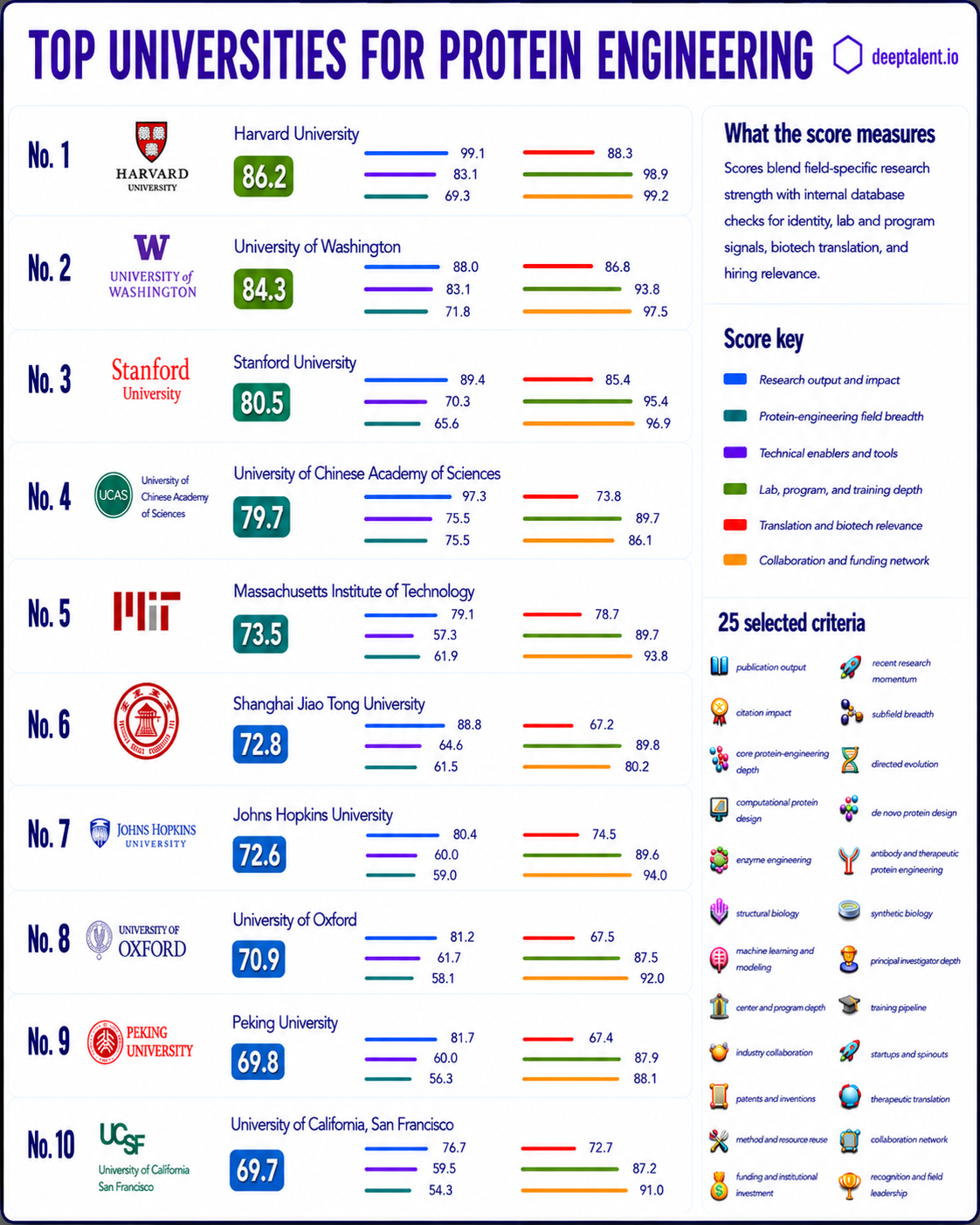
Top Universities for Protein Engineering Careers
Harvard, the University of Washington, UCSF, and leading Chinese universities point to different protein-engineering career paths across computational design, antibodies, translation, and company formation.
Protein engineering strength depends on the career someone wants to build. Computational design, therapeutic proteins, antibody engineering, enzyme engineering, structural biology, translation, startup creation, and biotech hiring can point toward different universities.
Harvard ranks first for breadth, the University of Washington sits close behind for computational protein design, UCSF remains a top translational choice, and several Chinese universities rank higher than many U.S.-centric career conversations would assume.
Harvard wins through breadth
Harvard’s advantage comes from breadth across antibody engineering, therapeutic proteins, structural biology, translational institutes, funding, company creation, and industry collaboration. That breadth matters for people who want a protein-engineering career tied to therapeutics, venture creation, hospital-connected translation, or broad biological discovery.
The career value is less about one famous lab and more about the number of doors a trainee can open across therapeutic areas and company environments.
Washington leads computational protein design
The University of Washington remains one of the clearest global centers for computational protein design. The Institute for Protein Design sits close to Rosetta, RFdiffusion, de novo design, machine-learning tools, therapeutics, and spinout activity.
For a candidate focused on computational design, model-guided protein creation, software, structure-based engineering, or de novo binder design, UW is an obvious anchor. UW still ranks second overall because protein engineering reaches beyond computational design alone.
UCSF connects translation and Bay Area biotech
UCSF’s strength is tied to translation, Bay Area biotech, therapeutic discovery, and strong industry paths. For protein and antibody engineering candidates, the nearby company environment matters because training can connect quickly to applied work in drug discovery and translational teams.
That career path can be especially valuable for candidates who want to move from academic training into therapeutic companies, platform teams, or discovery groups with a clear route into industry.
Chinese universities add research momentum
University of Chinese Academy of Sciences, Shanghai Jiao Tong, and Peking University rank strongly because of publication volume, field breadth, funding, synthetic biology, and research growth.
For global candidates and hiring teams, that matters because protein-engineering talent is increasingly international. Strong hiring strategies should include university context across the United States, Europe, China, and other major research ecosystems.
How candidates should use the ranking
Students and early-career scientists should pick programs based on the career they want to build. Computational design, therapeutic protein engineering, antibody discovery, structural biology, enzyme engineering, and startup translation each reward different training environments.
biotalent.ai uses university context as one part of a broader career view. The strongest career match comes from the combination of training, hands-on experience, company context, and the roles a candidate wants next.
The ranking uses breadth, translation, and career movement
The ranking rewards protein-engineering depth, subfield coverage, translation, industry collaboration, startup activity, training environment, and career movement into biotech.
That is why the result can put Harvard ahead overall while still treating the University of Washington as the clearest computational protein-design center. A student choosing a lab should map the ranking to the intended career path: de novo design, antibody engineering, enzyme engineering, structural biology, therapeutic translation, company formation, or platform work.