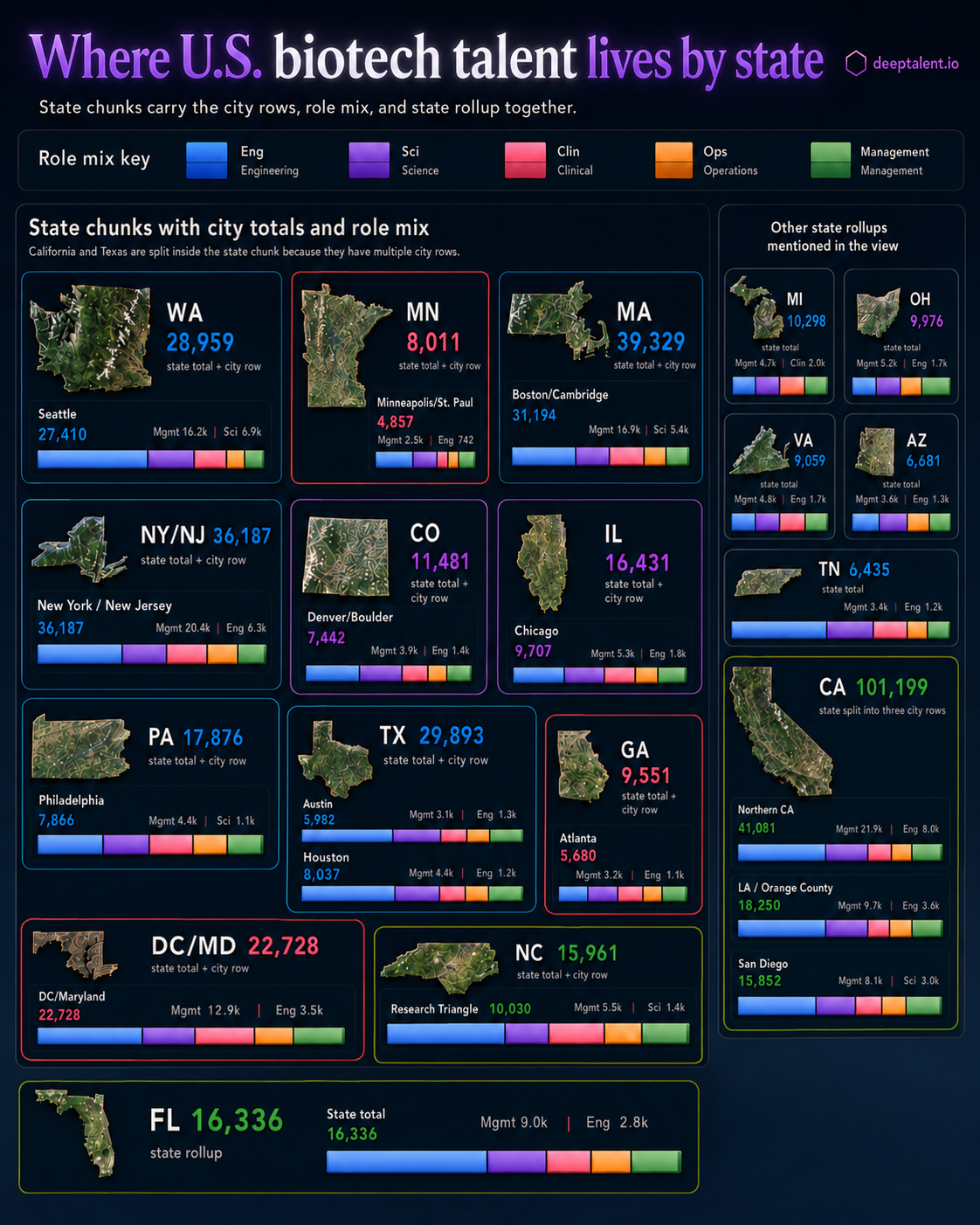
Where U.S. Biotech Talent Actually Lives
U.S. biotech talent is distributed across different cities by role, specialty, and company environment, which changes how candidates search and how hiring teams build pipelines.
The U.S. biotech market is geographically concentrated, but the concentration changes by role. A city that is strong for discovery biology may be weaker for CMC, quality, computational biology, clinical development, diagnostics, or platform engineering.
That matters for candidates choosing where to move and for hiring teams deciding where to search. The best city strategy depends on the role.
Biotech hiring is concentrated by role
Boston and the Bay Area still attract the broadest attention because they combine universities, venture-backed companies, pharma sites, platform companies, discovery teams, and experienced operators. But U.S. biotech hiring does not collapse into two cities.
San Diego, Research Triangle, Philadelphia, Seattle, Chicago, New York, New Jersey, Los Angeles, and Maryland each carry specialist strength. The right city depends on whether the role needs discovery scientists, process development, quality, clinical operations, computational biology, diagnostics, translational medicine, or platform engineering.
Candidate decisions
Candidates should evaluate cities through the role they want next. A scientist moving toward therapeutic discovery may read Boston differently from a process development leader comparing Research Triangle, New Jersey, Philadelphia, and the Bay Area.
A computational biologist may see more options in Boston, the Bay Area, Seattle, San Diego, or New York depending on company type. A quality or CMC candidate may care more about manufacturing depth and regulated operations.
Employer decisions
Hiring teams should avoid treating geography as a generic radius around headquarters. A narrow local search can work for common roles, but specialized biotech hiring often needs a city-by-city view of where the relevant people actually work.
The best search strategy changes when the role moves from R&D to clinical operations, CMC, quality, genomics, diagnostics, platform biology, or program leadership.
Remote work still needs city context
Remote and hybrid hiring expands the search, but it does not erase geography. Many candidates still live near prior employers, university networks, core facilities, CRO relationships, manufacturing sites, and investor-backed company centers.
That city context helps employers understand compensation, relocation, commuting, hybrid expectations, and the likelihood that a strong candidate will engage.
Search by role, not just city
biotalent.ai connects role requirements to candidate history, company context, and geography. That helps candidates find better jobs and helps hiring teams build a stronger pipeline of people who match the actual role.
The practical question is simple: where are the people who have already handled this role’s responsibilities?
Role mix changes the city map
The Bay Area leads the city view, New York and New Jersey form a major top-tier market, Boston and Cambridge remain a core scientific hub, Seattle carries a stronger engineering story, and Research Triangle stands out as a strong non-coastal alternative.
For candidates, that means a move should be judged by the jobs available in the desired function, not just the reputation of the city. For employers, it means a search for software, computational biology, CMC, quality, manufacturing, discovery, diagnostics, or program leadership may need a different city plan.